Stop Tracking AI Visibility. Start Tracking What AI Says About You.
Key takeaways
- Visibility rate tells you how often AI names you, not how it describes you. Track both.
- Start with business goals, then estimate your AI TAM, then build the prompt list. Not the other way round.
- Act only on evidence: read the real answers and see the sources behind them.
- Feed your briefs with context from every department.
- Prepare for agents that act for the user, not only recommend.
Free tool: AI search prompt generatorAnswer a few questions about your market and get 20 buyer prompts to test in ChatGPT, Gemini and Perplexity.
Generate my 20 prompts →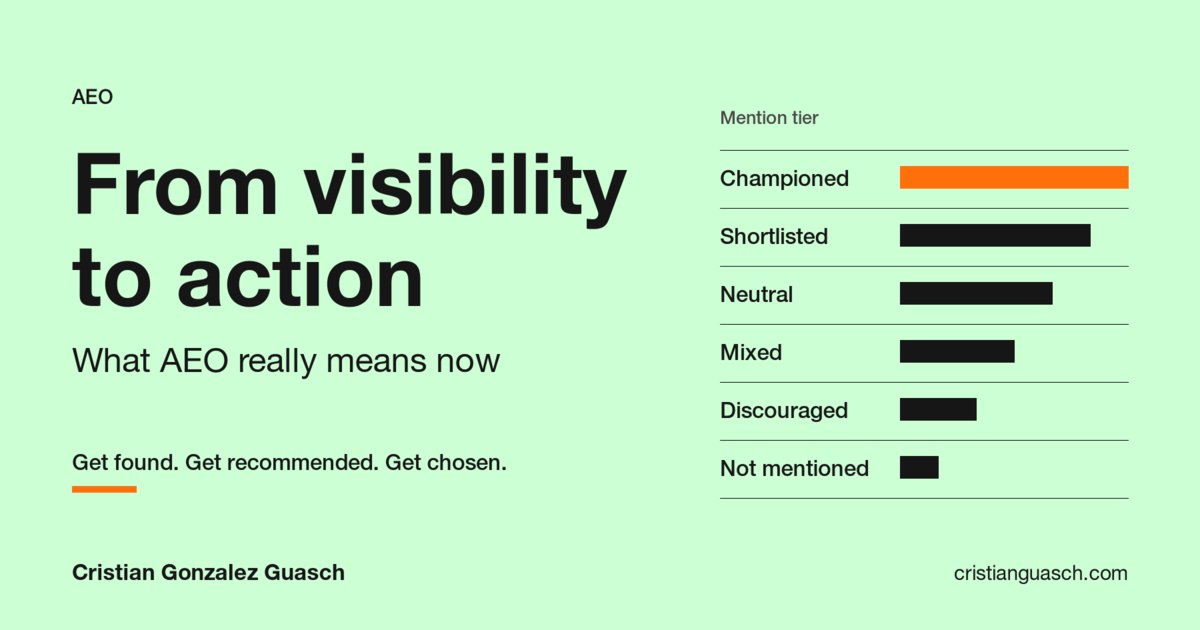
Open ChatGPT and ask it for the best tools in your category for a company like yours. Read the answer slowly.
Now imagine your tracking dashboard says you're "visible" in 42% of answers like that one. That sounds like good news. It isn't, if the answer says you're fine "if you don't need" the thing your best customers buy you for, or lists you last, or tells the reader to avoid you for the use case that pays the bills.
That's the problem with visibility rate on its own. It counts how often you're named. It doesn't tell you how you're described.
It matters now because buyers are moving there fast. In G2's March 2026 survey of 1,076 software buyers, 51% said they now start their research in an AI chatbot, up from 29% about eleven months earlier, and 69% ended up choosing a different vendor than they'd planned after chatbot guidance.
I've spent 18 years in SEO, and I've seen this movie before. Here is how I'd avoid repeating it.
Visibility rate is the new keyword rank
In the early days of SEO, teams tracked hundreds of keywords. Many were too generic to ever rank for. Many had nothing to do with revenue. The reports showed green arrows, and the pipeline didn't move.
AEO is repeating the pattern with prompts. Teams paste a few hundred into a tracker, watch a mention rate go up or down, and call it progress. The metric is easy to count and easy to misread, because a mention that says "avoid" counts the same as one that says "the best choice."
Three things get lost when you track visibility alone:
- How you're described. Are you recommended, listed as one option among many, or warned against?
- Where you appear. Being named first is not the same as being named fifth.
- Whether it's right. AI can state your pricing, features or positioning wrongly, and the visibility number never notices.
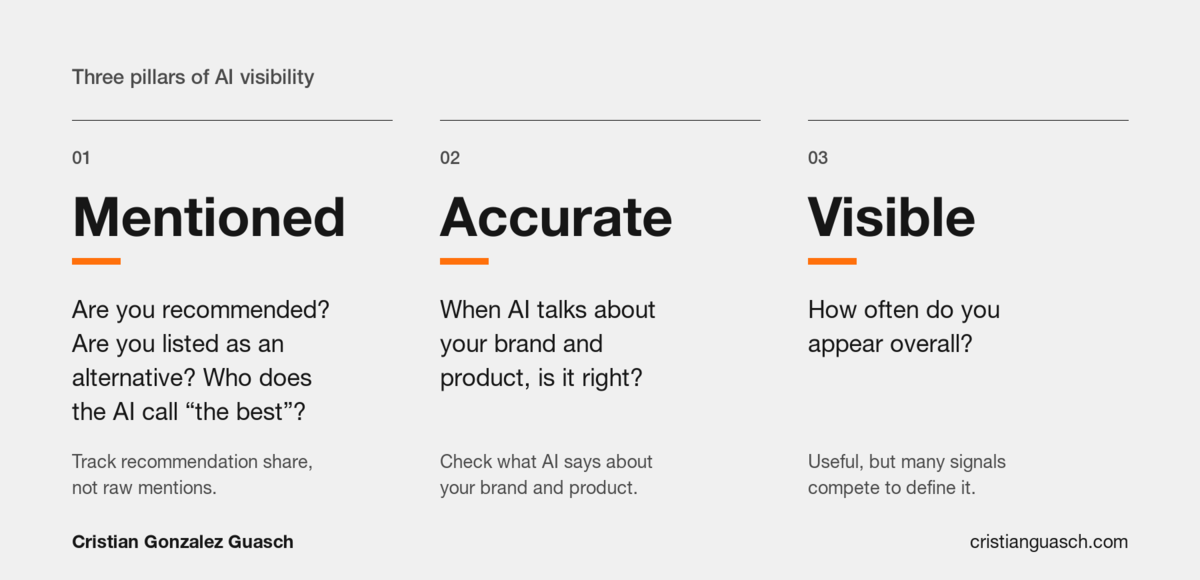
So I look at three questions, not one:
- Mentioned. Are you recommended? Are you listed as an alternative? Who does the AI call "the best"?
- Accurate. When AI talks about your brand and product, is it right?
- Visible. How often you appear overall. Useful, but only after the first two.
Recommendation share beats raw mentions
The number worth tracking is recommendation share: your mentions, plus a breakdown of how the AI frames you. I sort every answer into a ladder:
| Mention tier | What it means |
|---|---|
| Championed | The AI actively recommends you as the answer |
| Shortlisted | You're one of a few options it suggests |
| Neutral | Mentioned without a clear stance |
| Mixed | Positives and negatives in the same breath |
| Discouraged | The AI steers people away from you |
| Not mentioned | You're absent from the answer |
The goal is to move prompts up this ladder, toward championed.
A prompt to calculate it yourself
You can run this on any set of answers. Copy the prompt below, paste it into the LLM of your choice, and it will first ask you for your brand, your competitors and the answers you collected. My recommendation: use only one platform, one region and one month of data, for example ChatGPT, only the USA, the month of November. Mixing platforms, countries or months blurs the picture and makes next month's comparison useless.
You are an AI search analyst. Your job is to measure my brand's recommendation share from AI answers I will give you. Work in two phases.

PHASE 1: Ask me for the inputs, then wait.
Ask me for the following, all in one message, and do not continue until I reply:
1. My brand name (and any alternative spellings).
2. My main competitors (3 to 10 names).
3. The platform the answers come from. Use ONE platform only (example: ChatGPT).
4. The region the answers were collected in. Use ONE region only (example: USA).
5. The month of data. Use ONE month only (example: November).
6. The answers: for each prompt I tracked, the prompt itself and the full answer the AI gave. Ask me to paste them numbered (Prompt 1 + Answer 1, Prompt 2 + Answer 2, and so on). If I have several answers for the same prompt in that month, ask me to paste all of them.
Tell me to keep platform, region and month the same for every answer, because mixing them makes the numbers meaningless. If I give you more than one platform, region or month, ask me to pick one before you analyze anything.

PHASE 2: Classify and calculate.
Classify every answer into exactly one mention tier for my brand:
- Championed: the AI actively recommends my brand as the answer.
- Shortlisted: my brand is one of a few options it suggests.
- Neutral: my brand is mentioned without a clear stance.
- Mixed: positives and negatives about my brand in the same answer.
- Discouraged: the AI steers people away from my brand.
- Not mentioned: my brand is absent from the answer.
Rules: judge only what is written in the answer, do not use outside knowledge, and do not invent anything. If an answer is ambiguous, pick the lower tier and say why.

Then give me:
1. A table with one row per answer: prompt number, tier, and a short quote (under 15 words) that justifies it.
2. Recommendation share: the count and percentage of answers in each tier, plus these totals: Mention rate (every tier except Not mentioned), Positive share (Championed + Shortlisted), and Negative share (Mixed + Discouraged).
3. The same breakdown for each competitor I listed, so I can compare my share against theirs.
4. The 3 prompts where I am weakest (Not mentioned or Discouraged), and what the answers say about me or my competitors there.
5. Three actions to move prompts up the ladder toward Championed, each tied to evidence from the answers (for example a source the AI cited, a claim it got wrong, or a competitor it preferred).
Finish with one line stating the platform, region and month this analysis covers, so I can compare it with next month.
Start with the business goal, not the prompt list
The better sequence runs the other way: business goals → AI TAM → prompt index → actions.
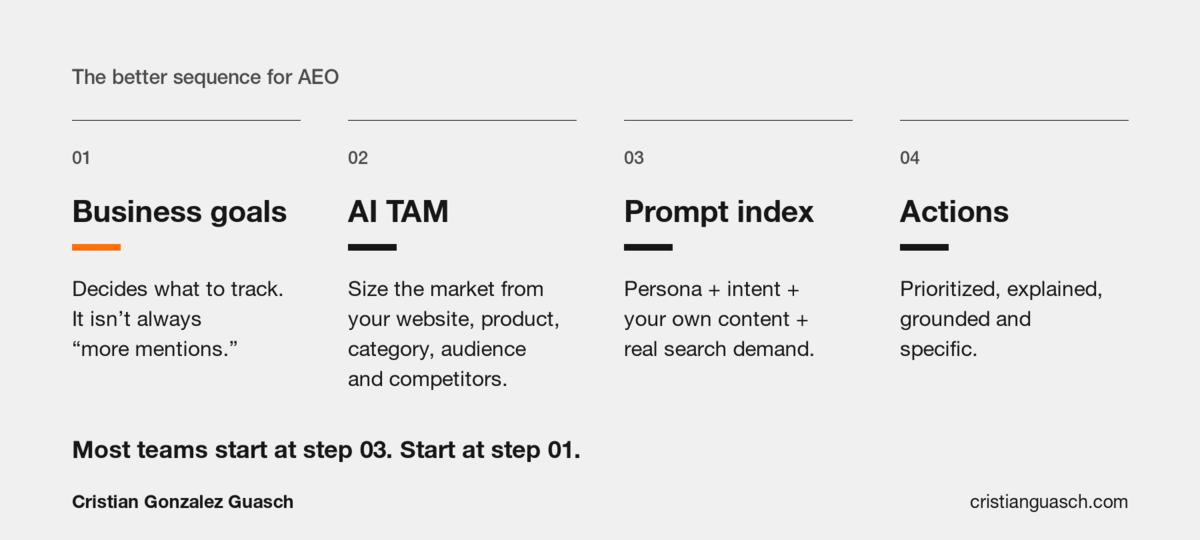
The goal decides what to track, and it isn't always "more mentions." Different companies use AI visibility data in very different ways, and the list keeps growing. These are some examples, not the full picture:
- Pipeline and demo requests from AI recommendations
- NPS and brand sentiment
- Product feedback
- Competitor benchmarking
- Industry and market research
- Sales insights
- Support (what AI tells customers when they hit a problem)
Pick the one or two that matter to your business this quarter. Everything after this step gets easier, because every prompt either serves the goal or it doesn't get tracked.
There's no search volume for AI, so estimate your AI TAM
SEO sized markets with search volume. AI gives you none. No LLM shares data on the specific questions people ask, so nobody can tell you how often a prompt is typed. Tools work around that in different ways: some call the models through their APIs, others scrape the responses, and each collects its data slightly differently. Either way, the prompts they track are samples that someone chose, not real user queries.
There's a deeper reason, too. People don't just type keywords into AI the way they did into a search box. They hold a conversation: they explain the situation, ask follow-ups, compare options and decide, sometimes even take action, all in one thread. A single keyword volume can't capture that. So you have to estimate.
I call the result your AI TAM: the topics and prompts where an AI could recommend you, and how much demand sits behind them. Here is how I build it.
- Gather five inputs. Your website, your product or service (positioning, messaging, features and so on), your category, your audience (ICP, personas, segments) and your competitors.
- Map topics. From those inputs, list the topics your buyers ask about: the problem, the options, the comparisons, the objections.
- Add persona and intent. The same topic is a different prompt for a head of security comparing vendors and a founder asking what a tool is.
- Use real demand as a proxy. Keyword search volume, your Search Console impressions, your site search, sales call questions and support tickets all tell you what people actually want to know.
- Count the prompts in play. For each topic, how many realistic prompts exist, and how much demand sits behind them?
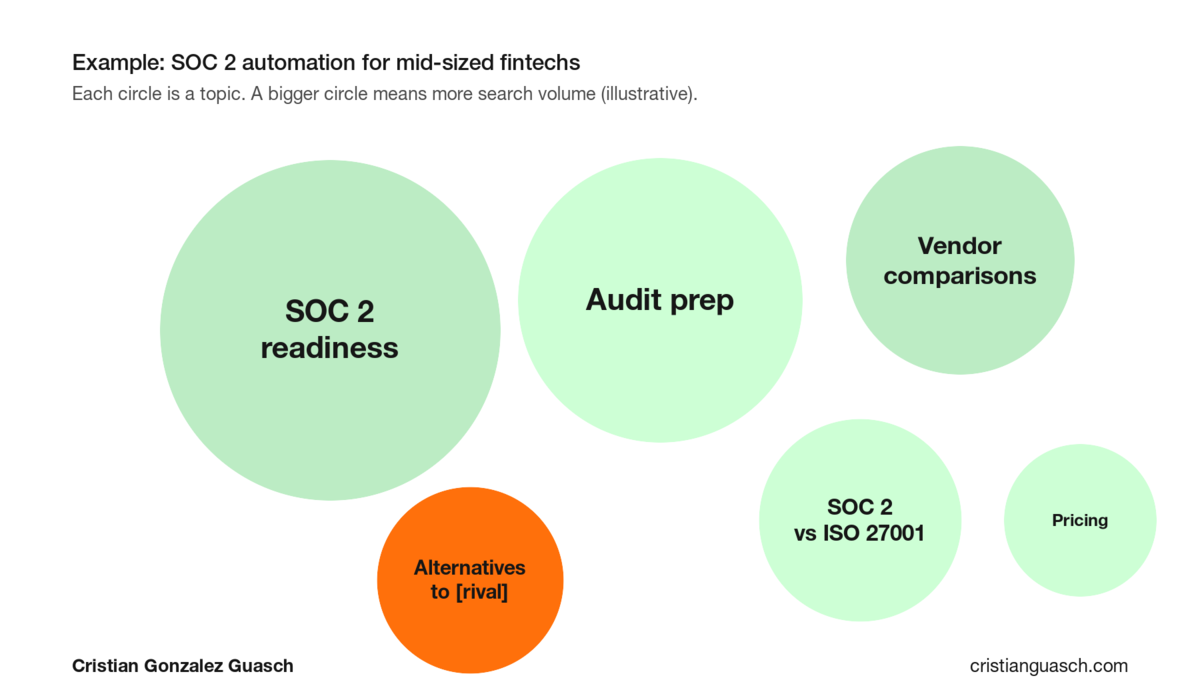
The output is a short list of topics worth tracking, not a long list of prompts. For example (illustrative only): say you sell SOC 2 automation software to mid-sized fintechs. The persona is a head of security. The intents are to learn, compare and shortlist. The topics are SOC 2 readiness, audit prep, vendor comparisons and "alternatives to" your biggest rival. You size each with keyword volume and your own impressions, and end up with a few dozen prompts that matter instead of a few hundred that don't.
How to define a prompt
A useful prompt is persona + intent + your own content + real search demand. Intent covers comparisons, recommendations, pricing, alternatives and so on. "Best software" is too generic to learn anything from. "Best SOC 2 automation tool for a 150-person fintech" is a prompt a real buyer could type, and one you can win.
To turn your category into a starting set, use my free AI search prompt generator. Fill in up to 18 fields about your market, and it gives you 20 buyer-style prompts you can copy all at once.
The blind spots are real: the prompts you didn't think of, how your brand shows up inside them, and the fact that you only ever see a small fraction. That's why you track a focused set over time and watch the trend, not any single answer.
Act only on evidence
The real blocker in AI search isn't data. It's overwhelm. The list of possible actions keeps growing, and there is no easy line from insight to impact. The way through is to act only when you can see what's happening in the answers for your own brand.
Before you change anything, check four things:
- Read the actual answers. Not the score. The words.
- See the sources behind them. Which pages, reviews, videos and threads did the AI lean on?
- Place each prompt on the ladder. Championed, shortlisted, neutral, mixed, discouraged or not mentioned.
- Compare with whoever is winning. What do they have that the AI can point to and you don't?
Then use the tier to decide what to do next, because each tier usually points to a different kind of work:
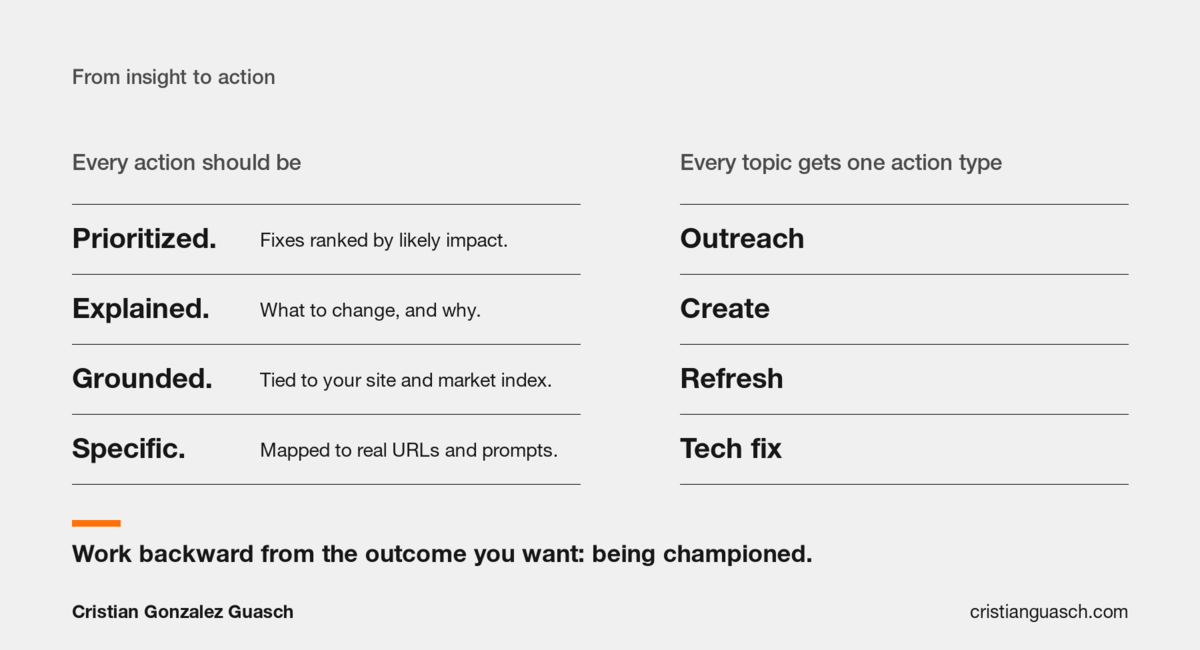
- Not mentioned. Find out why. No page that answers the question: create one. A thin or outdated page: optimize or refresh it. Sources that never talk about you: a third-party mention campaign in reviews, comparisons, lists and communities. If the answer leans on video, a video may be the missing piece.
- Discouraged. Find the source of the negative framing: an outdated page, a review, a competitor comparison or a real product gap. Fix what's inaccurate and answer what's fair.
- Mixed. Refresh pages to make the strengths clearer, address the objections that show up in the same breath, and add proof.
- Neutral. Give the AI a reason to recommend you: clear positioning, specific use cases, comparison content and evidence.
- Shortlisted. Win head to head with "X vs Y" and "best for" pages, and earn placement in the third-party lists where you aren't yet in the first few.
- Championed. Protect it. Keep pages fresh and extend what works to neighboring prompts.
Every action should be prioritized, explained, grounded in your own site and AI TAM, and specific: "create this page," "refresh this description," mapped to real URLs and prompts.
The other half is what others say about you
An AirOps study from October 2025 looked at 21,311 brand mentions across more than 500 discovery-stage queries. It found that 85% of brand mentions came from external domains, and only 13.2% came from the brand's own domain. Nearly 90% of third-party mentions came from listicles, comparisons and reviews. The study covers top-of-funnel queries, and AirOps sells AI visibility software, but the direction is clear: if you only fix your own site, you're working on the smaller half.
Better briefs come from every department
When you know what to create or refresh, the brief decides whether the result is any good. A good brief specifies content type, persona, journey stage and suggestions. It then layers in what AI can't invent: notes from subject-matter experts, original research and industry data, and product specs.
Behind the brief sits a context layer most teams skip. AI can write fast, but it can only write from what it knows, and what it needs to know doesn't live in the SEO team. Building it takes input from several departments:
- Product marketing. ICP and personas, positioning, messaging, differentiators and competitor benchmarks.
- Sales. Call transcripts, objections, the questions buyers really ask and the words they use.
- Support and customer success. Feedback, tickets, recurring problems and how customers describe them.
- Product and engineering. Specs, features and limits, so every claim is true and current.
- Brand and content. Voice and tone, examples of good human writing, words and sentences to avoid, copywriting skills, and writing and structure rules for each page type.
- Legal and compliance. The claims you can and can't make.
- SEO and AEO. Update rules, intent and coverage checks, and the prompts and citations a page should be built around.
Examples of good human writing do more work than rules alone. Without this layer you get fluent, generic content that sounds like every competitor. With it, a draft carries your positioning, your buyers' own language and facts that are true.
When the agent does the buying, a healthy site isn't enough
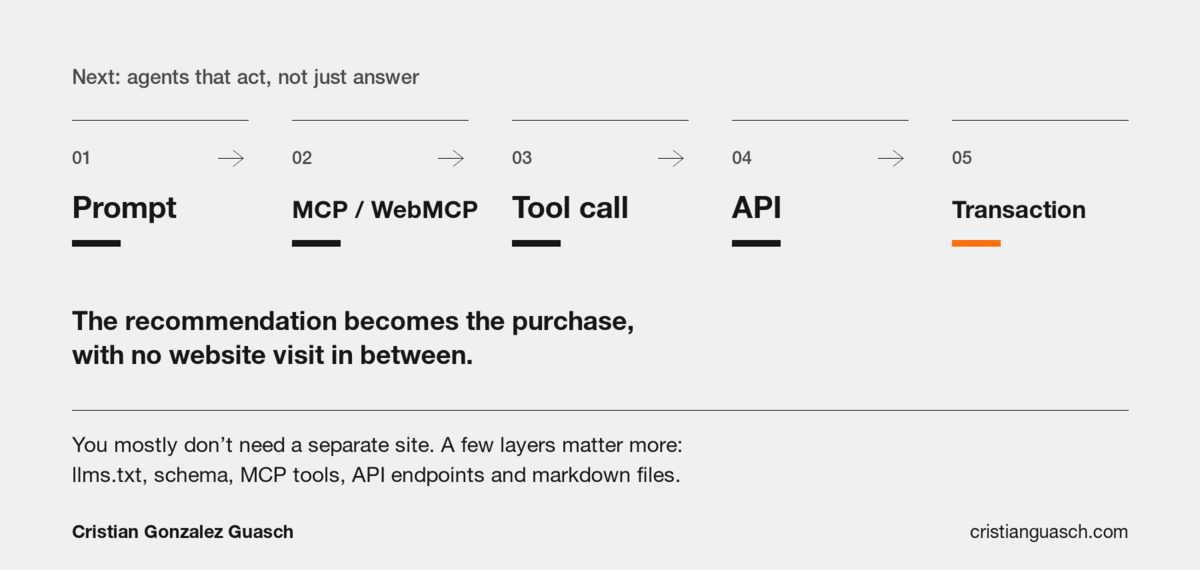
Recommendations are only the first step. Once you're visible and recommended, AI agents start taking actions for the user: prompt → MCP / WebMCP → tool call → API → transaction. The recommendation becomes the purchase, with no website visit in between.
It's already happening in shopping. OpenAI launched Instant Checkout in ChatGPT on September 29, 2025, with a "Buy" button inside the chat. Google followed in January 2026 with the Universal Commerce Protocol, for checkout in AI Mode and the Gemini app.
It reaches software too. Coding agents such as Codex and Claude Code can connect to tools through MCP and call APIs, so a developer can ask for a result and let the agent use your product to get it. The person may never open your interface or see your pricing page. If your product is hard for an agent to operate, it will quietly use something that isn't.
So the question isn't only "is our site technically healthy?" It's "can an agent read it, trust it and act on it?" You mostly don't need a separate site, but a few layers matter more than before:
| Layer | Why it matters |
|---|---|
| Rendering | Your site has to be rendered so search engines and LLMs can read it, not only after a browser runs JavaScript |
| llms.txt | Not useful for content discovery; possibly useful for agent actions |
| Schema | Structured facts machines can trust |
| MCP tools | Let agents act on your product directly |
| API endpoints | How an agent actually places the order or takes the payment |
| Markdown files | Clean, parseable versions of key content |
Underneath it all, the fundamentals haven't changed: great content, a healthy technical site and earned authority. Treat all of it as a practice, not a project.
The tool I recommend for the evidence: LLM Pulse
Every step above depends on one thing: seeing what the AI actually says about you. Not a score. The answers, the sources behind them and how they change over time. That's the job I'd give LLM Pulse.
LLM Pulse was created by Esteve Castells, who I worked with at Softonic. He has been doing SEO as long as I have, for top companies, and I trust him and support what he built. Today I think the product is well suited for most companies that want to do what this article describes.
I also built an AI visibility tracker of my own, Decoding, and took it to 70 users, so I know what this kind of tool has to do. I wound it down as the market consolidated around heavily funded competitors.
Disclosure: the LLM Pulse links in this post are affiliate links. If you sign up through them, I may earn a commission, at no extra cost to you.
Here is how it maps to what this post says to do. Every item below comes from LLM Pulse's own site.
| What this post says to do | What LLM Pulse gives you |
|---|---|
| Define goals and organize prompts around them | Prompt tags, plus annotations that mark content changes and campaigns on the visibility timeline |
| Find the prompts worth tracking | Prompt Research from a domain or search term, AI prompt suggestions, and a view of the related queries ChatGPT runs behind the scenes |
| See how the AI talks about you | Every tracked answer, readable in full, with highlighted mentions, citations and per-response sentiment. Brand sentiment flags where models misrepresent you. |
| Compare against whoever is winning | Share of voice, mention rate, an AI Visibility Score weighted by position, and competitor comparisons across five AI models |
| Act on evidence, not hunches | The cited URLs and domains AI trusts, YouTube and Reddit sources, and recommendations that link back to the answers behind them |
| Write better briefs | A GEO Writer that produces briefs and drafts from your tracked prompts |
| Prepare for agents | Agent analytics for AI crawlers and browsing agents in your server logs, GEO audits of robots.txt and llms.txt, and an MCP server, API and CLI so your own agents can use the data |
| Prove it moved something | AI referral sessions, conversions and revenue through GA4 and other analytics tools |
It tracks ChatGPT, Perplexity, Google AI Overviews, Google AI Mode and Gemini on every plan. Team members are unlimited, and weekly plans start at $48 a month on annual billing, or $58 month to month.
What it won't do for you
Honesty matters here, because the answers are probabilistic and the prompts are synthetic. No tool can tell you what a specific buyer saw. And by its own site, LLM Pulse measures mentions, sentiment and share of voice. The mention-tier ladder and your AI TAM are the thinking you bring to it, and I'd rather you know that before you buy.
Try it on your ten prompts
The cheapest way to find out is to test it on real prompts. Pick the ten questions a buyer would ask before choosing a vendor in your category, track them for two weeks and place each answer on the ladder. Eligible new customers can start with a 14-day free trial. If after two weeks you can't say how AI describes your company, you've lost nothing but a little time.
What to do this week
- Write down the ten questions a buyer would ask before choosing a vendor in your category: what it is, which tools solve it, how two compare, who to pick. The AI search prompt generator will draft 20 for you in a minute.
- Run each one in ChatGPT, Gemini and Perplexity, or track them in LLM Pulse. Note whether you're named and how the AI describes you, then place it on the ladder.
- Pick the three prompts where a small fix would move you up a tier. For each, decide whether it needs a new page, a refresh, a technical fix or a mention from someone else.
That's a few hours of work, and it will tell you more than most AI visibility reports.
What waiting costs
You won't see it in your analytics. There's no visit, no form fill and no "lost" stage in your CRM. Every week you stay off the shortlist, buyers choose among the companies that are on it.
If you'd like a second pair of eyes
Send me your website and the three questions you'd most want a buyer to ask an AI tool. Within two business days I'll send you a free AI visibility check: who the AI tools name today, whether you're one of them, and what I'd fix first. I take a limited number of clients each month, because I bring real attention to each one. No pitch deck, and no retainer to sign up for. If it's not a fit, I'll tell you.
Get my free AI visibility check →

Cristian Gonzalez Guasch
AI search and SEO consultant in Brooklyn. I work on AI visibility at Cockroach Labs and take on a few NYC B2B software clients. About me
Get started
Here's how to start
Send me your site and the three questions you'd most want a buyer to ask an AI tool.
Within two business days I'll send a free AI visibility check: who gets named today, whether you're one of them, and what I'd fix first.
No pitch deck, and no retainer to sign up front. If it's not a fit, I'll tell you.
Get my free AI visibility check →Or email me directly at cristian@vidian.es.